



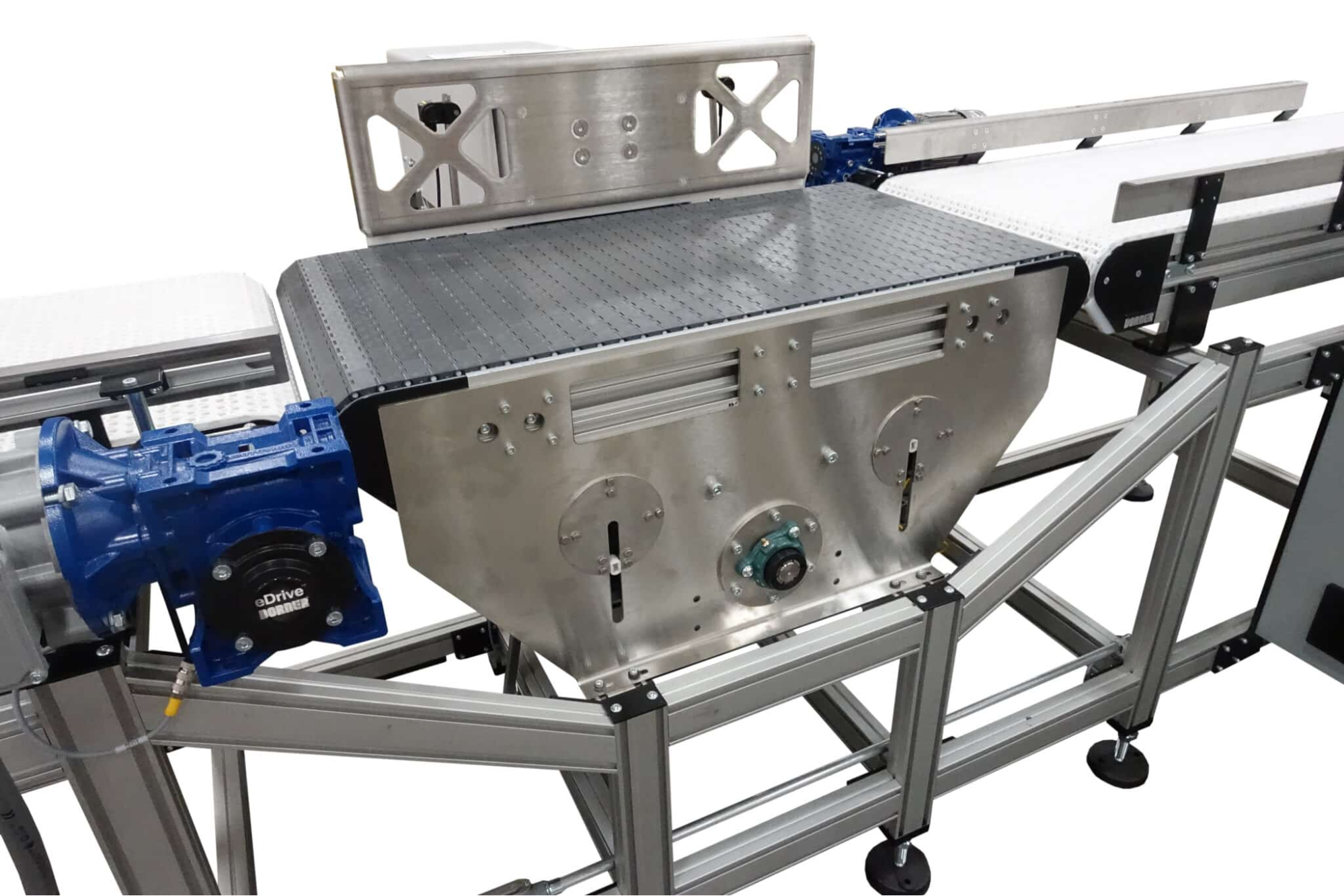
Every plant has one. A conveyor line that’s been running since before half the current maintenance team was hired. It still moves product. It still “works.” But it also breaks a little more often than it used to, needs a specialist to track down parts, and quietly shapes what your operation can and can’t do.
That’s the hidden cost of an aging line. It’s rarely one dramatic failure, but a slow accumulation of quick fixes and workarounds. A changeover that takes twenty extra minutes, a throughput ceiling nobody planned for, a layout that can’t accommodate the next automation project without a rebuild. None of it shows up as a single line item. All of it shows up in the numbers eventually.
The question isn’t whether to do something about an aging conveyor. It’s which of three very different options actually solves the problem: repair, retrofit, or replacement. That’s what this guide is here to explore and answer for you.
Repair, Retrofit, Replacement: Three Different Decisions
These terms get used interchangeably, but they answer different questions, and confusing them leads to spending money in the wrong place.
- Repair fixes what’s broken and returns the line to its original spec. It doesn’t change what the conveyor can do.
- Retrofit upgrades specific components (drives, controls, belting, guarding, sections of frame) to improve performance, reliability, or fit within the existing footprint. The core system stays, but its capability changes.
- Replacement swaps the line, or a major section of it, for a new industrial conveyor system engineered around where the operation is headed, not just where it’s been.
Repair answers “how do we get this running again.” Retrofit answers “how do we make this do more without starting over.” Replacement answers “what does this line need to look like for the next decade.” Treating all three as the same decision is how plants end up repairing something three times that should have been retrofitted once, or retrofitting a system that’s already fighting its own layout.
A Simple Decision Framework
Before committing to a path, walk through these questions honestly:
- Is the failure isolated or systemic? One motor, one bad splice, one sensor – that’s a repair. Recurring failures across multiple zones point to a bigger problem.
- Is the constraint mechanical or architectural? If the conveyor can’t hit throughput goals or fit footprint you need no matter what parts you swap, that’s a layout problem, not a maintenance problem.
- What’s the real cost of downtime right now? A line that costs you an hour of downtime a month tolerates more risk than a line that costs you an hour a day.
- Does this line need to support something it wasn’t built for? New product, added automation, tighter sanitation standards, a new SKU mix, etc. Check whether the current system was ever engineered for that.
- What’s the remaining useful life, honestly? Not “how long could it theoretically keep running,” but “how long before the next fix costs more than it’s worth.”
If the answers point to an isolated issue on a system that still fits your operation, repair.
If they point to a system that’s fundamentally sound but under-equipped for where the plant is going, retrofit.
If they point to a line that’s structurally out of step with your floor space, throughput, or operational needs, it’s time to talk replacement.
When Repair Still Makes Sense
Repair is the right call more often than people assume, especially when a line is otherwise healthy. A worn belt, a failing bearing, a drive that’s overheating, all of these point to normal wear, not signs of a system in decline. If the conveyor is meeting throughput, fits the current layout, and the failure is a known, contained issue, fix it and move on.
The trap is repeat repair on the same component or zone. If you’re replacing the same drive or patching the same section of frame every few months, that’s a sign the system is being asked to do more than it was designed for, and repair has quietly become a stopgap. A preventative maintenance program is the best way to tell the difference between routine wear and a pattern worth escalating, since it gives you a baseline for what “normal” actually looks like on that line.
When Retrofit Is the Smarter Move
Retrofit is often the most capital-efficient path, and it’s underused because “replacement” gets more attention. It makes sense when the core structure of the line is sound but specific components are holding back performance: outdated controls, inflexible drive configurations, belting that can’t handle a new product, or a layout that needs modular sections to adapt to a changing floor plan.
Modular conveyor platforms are what make retrofit realistic instead of theoretical. A system like Dorner’s FlexMove is built to reconfigure — add curves, extend runs, change direction — without a full engineering redesign, which means a retrofit can solve a layout problem that would otherwise require tearing out the whole line.
Retrofit is also the right move when the goal is closing a specific gap, like better indexing precision, multi-SKU sorting, or higher speed, without disrupting everything around that section of the line.
When Replacement Is the Better Investment
Replacement earns its cost when the limitation isn’t a component, it’s the system itself. A few honest signals:
- The line is fighting its own footprint, and no retrofit gets it to fit.
- Downtime and repair costs have become a challenge rather than an occasional one.
- The system can’t meet current sanitation, changeover, or throughput standards no matter what’s swapped out.
- Parts availability is becoming a real risk, not a minor inconvenience.
- The line was never engineered for the product, speed, or automation the plant runs today.
In these cases, retrofitting isn’t cheaper: it’s slower, riskier, and still leaves you with an architecture that doesn’t meet operational needs. A custom-engineered system built around your actual product, floor plan, and throughput target resolves the root problem instead of managing around it. This is usually where the math changes. The “expensive” option is the one that stops the recurring cost, and the “cheap” option is the one that keeps generating it.
How Floor Space, Sanitation, and Throughput Change the Answer
These three constraints are what usually tip the decision one way or another, because they’re the ones a component swap can’t always fix.
Floor space. An aging line laid out for a plant that’s since added equipment, cells, or product lines often can’t be retrofitted into a tighter footprint, it needs a different architecture. Space-saving conveyor configurations are worth reviewing before assuming a full facility rebuild is required. Sometimes the fix is a smarter path through existing space, not more square footage.
Sanitation. In food, beverage, or pharmaceutical production, an old line built to older cleaning standards is a compounding liability. Every changeover takes longer, and every audit gets harder to pass. This is one area where retrofit rarely closes the gap completely, because hygienic design (open frames, quick-release belting, minimal harborage points) is structural, not add-on. A sanitary platform like AquaPruf is built around that standard from the frame up, which is why food and beverage plants often move straight to replacement once changeover time becomes a bottleneck.
Throughput. If demand has grown past what the line was designed for, retrofitting speed onto an undersized system usually just moves the bottleneck somewhere else, like onto a transfer point, a merge, or an accumulation zone. Understanding how accumulation and flow actually work on the line will usually tell you whether the fix is targeted or whether the whole line needs to be resized.
How to Think About Future Automation and Integration
The mistake most plants make is deciding based only on what the line needs to do today. If there’s any realistic chance of adding robotics, AGVs, vision systems, or warehouse automation in the next few years, that has to factor into the decision now. Retrofitting an old line to interface with new automation is usually harder and more expensive than building automation-ready from the start.
This is where replacement often pays for itself over a longer horizon. A system designed with integration in mind (think standardized controls, consistent interfaces, and room for expansion) avoids the pattern where every new automation project requires another round of conveyor work just to make the connection possible. If automation is even on the five-year roadmap, it belongs in this conversation, not a separate one later.
What to Ask Your Conveyor Partner Before Committing
Whichever direction the decision points, come to the conversation with a partner who will tell you the honest answer, not just sell the bigger project. Ask:
- What’s actually causing the failure or limitation — is it the component or the architecture?
- If we retrofit, what’s the realistic remaining life of the rest of the system?
- What does this decision cost us in downtime during the transition, not just in equipment?
- How will this system need to support automation or integration we haven’t added yet?
- What does installation look like around our production schedule — can this be phased?
- What ongoing maintenance and training does the new or retrofitted system require, and does our team have it?
A good answer to these questions should point clearly toward one path. If it doesn’t, that’s usually a sign that more diagnostic work is needed before spending anything.
FAQ
How do I know if my conveyor needs a retrofit or full replacement?
If the core frame and layout still fit your operation and the issue is specific — controls, drives, belting, a section that needs more flexibility — retrofit usually solves it. If the limitation is the layout, footprint, sanitation standard, or throughput ceiling itself, replacement is the more durable fix.
Is retrofitting always cheaper than replacing a conveyor?
Not always. Retrofit has a lower upfront cost, but if the underlying architecture can’t support what the plant needs, a retrofit can end up as a temporary fix that gets revisited again in a year or two. Compare total cost over time, not just the initial invoice. MHI publishes broader material handling lifecycle-cost data worth benchmarking against.
What’s a realistic lifespan for an industrial conveyor system?
It depends heavily on application, duty cycle, and maintenance history, which is why remaining useful life should be assessed case by case rather than by age alone. A well-maintained system can run well past its original design life; a poorly matched one can fall short of it.
Can I retrofit a conveyor to prepare it for future automation?
Sometimes, if the base architecture is modern enough to support updated controls and integration points. Older systems often can’t accommodate this without significant rework, which is worth factoring into the retrofit-versus-replace decision early.
Should sanitation requirements change the decision?
Often, yes. Hygienic design is largely structural — frame geometry, belt access, wash-down tolerance — so plants facing tighter sanitation or changeover requirements frequently find that replacement with a purpose-built sanitary platform resolves issues a retrofit can’t fully address.
Ready to Make the Right Call?
An aging conveyor line rarely announces the moment it’s become a liability, it just keeps costing a little more each quarter until someone adds it up. If you’re weighing repair, retrofit, or replacement, Dorner’s team can help you diagnose the real constraint before you spend on the wrong fix. Talk to us about a custom-engineered system built around where your operation is headed, not where it’s been.